Livingstone and Victoria Falls
Zambia's gateway to Victoria Falls, Livingstone combines the 108-meter curtain of water of the Zambezi, gorge rafting and Toka-Leya villages.
Livingstone occupies the southwestern corner of Zambia, on the northern bank of the Zambezi, 470 kilometers from Lusaka via the T1 highway. The town is named after the Scottish explorer who reached the falls in November 1855 and retains, in its center, several buildings from the British colonial era aligned along Mosi-oa-Tunya Road. The national museum here preserves objects related to exploration and the Lozi, Toka-Leya and Tonga peoples who have inhabited the region for centuries.
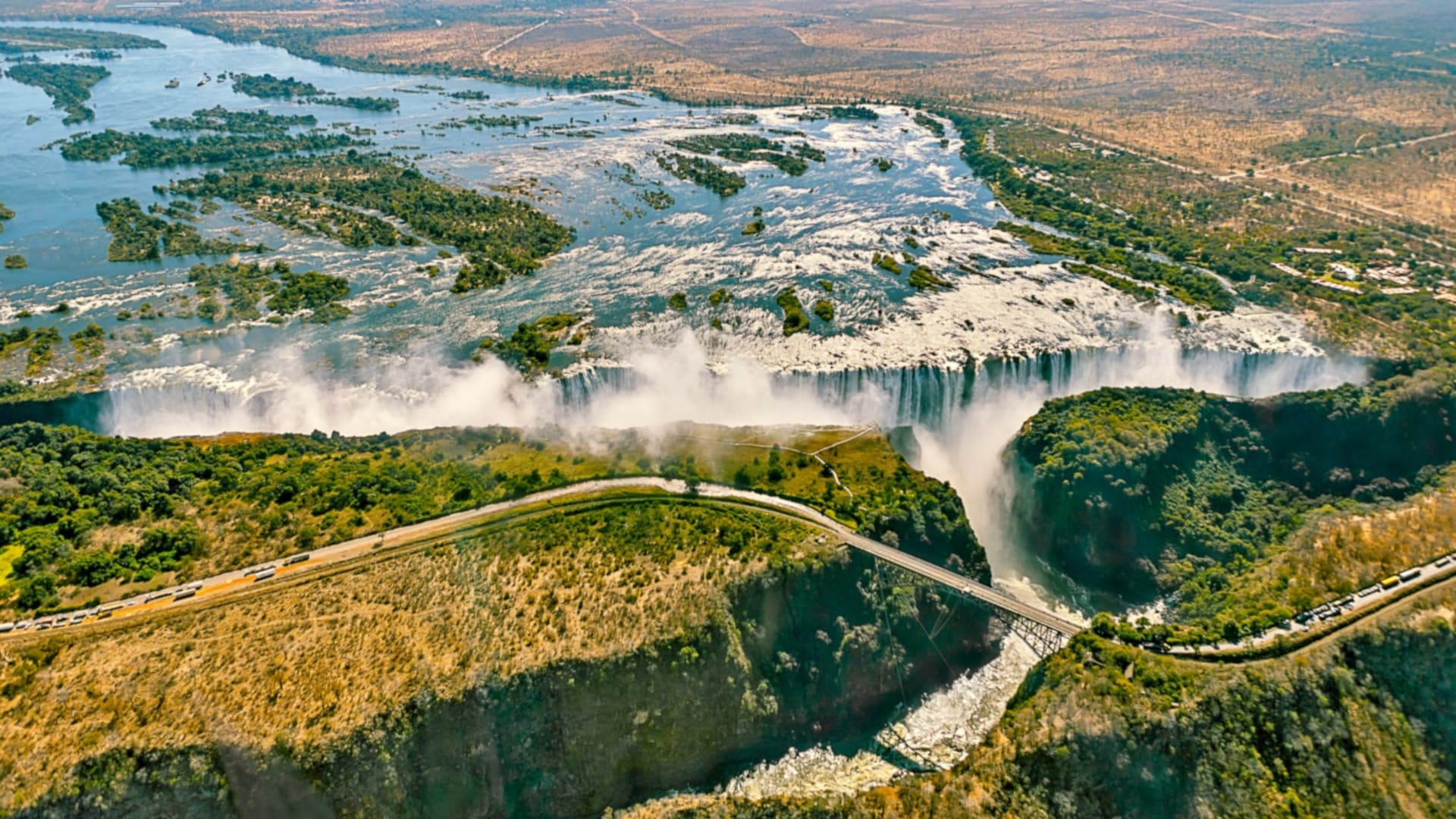
The heart of the region is undoubtedly Mosi-oa-Tunya, "the smoke that thunders," the local name for Victoria Falls. The Zambezi, approximately 1,700 meters wide at this point, plunges as a single block 108 meters into a narrow basalt fissure, creating a plume of vapor visible for 30 kilometers in clear weather. Mosi-oa-Tunya National Park, which borders the falls on the Zambian side, also shelters reintroduced white rhinoceros, giraffes and zebras across a modest 66 km² area. It is one of the few parks in the country where you can undertake a guided walking safari accompanied by armed rangers.
The climate is subtropical at low altitude, around 900 meters. Geography has shaped everything: the Zambezi Gorge downstream of the falls, 120 meters deep, attracts whitewater rafting enthusiasts, with rapids numbered 1 to 25, several of which are classified as Grade V. Upstream, the river widens, passes through flat islands covered with ilala palms and fig trees, and this is where sunset cruise boats operate in the late afternoon.
The region's economy is largely tourism and cross-border trade oriented. The Victoria Falls Bridge, inaugurated in 1905, connects Zambia to Zimbabwe and remains a strategic crossing point for regional commerce. The Toka-Leya villages on the periphery of Livingstone, such as Mukuni 10 kilometers to the southeast, perpetuate traditional organization centered on a chief and derive some income from the sale of crafts at Mukuni Park market in the city center. Nshima, a maize porridge accompanied by goat meat or dried Zambezi fish (kapenta, bream), constitutes the daily staple.
Livingstone remains the international gateway to southern Zambia thanks to Harry Mwaanga Nkumbula Airport, which receives direct flights from Johannesburg, Nairobi and Cape Town. The town retains a compact format—you can cross the center on foot in fifteen minutes—and concentrates bush lodges, guesthouses and riverside hotels. For us, it is also the logical articulation point with neighboring Botswana (Chobe is 80 kilometers away) and with the rest of Zambia via domestic flights to Mfuwe or Jeki.
Beyond the falls themselves, the region offers a rare density of activities: 15 or 30-minute helicopter flights over the chasm, bridge jumping (111 meters), zip-lining down the gorge, swimming in Devil's Pool on Livingstone Island during low water season, and sunset on the Zambezi with hippopotamus in the background. It is this combination—spectacular landscape and accessible terrain—that makes Livingstone a 3 to 4-night stop in most of our itineraries.
To discover
Knife-Edge Bridge facing the First Gorge. The footbridge crosses a tongue of rock drenched by spray. In February-March, you emerge entirely soaked, with a plunging view of the water curtain crashing 100 meters below.
Devil's Pool on Livingstone Island. Natural basin at the very edge of the drop, accessible only from mid-August to mid-January when water levels permit. Boat crossing from Royal Livingstone Hotel, then short walk through the dried riverbed.
Rafting in the Zambezi Gorge. 24 km descent downstream of the falls, between 18 and 25 rapids depending on season (low water August to December). Several sections are Grade V, with exit via metal ladder along the 200-meter cliff face.
Mukuni Village and Toka-Leya market. Traditional capital of the Mukuni chiefdom, inhabited since the 13th century. Meet the mukwa wood sculptors and women who weave baskets from ilala palm leaves.
Sunset cruise on the upper Zambezi. Three hours on the river upstream of the falls, among hippopotamus and crocodiles. The low-angle light illuminates the banks and flights of Egyptian geese heading to their roosts.
When to go
From February to May, the period following the rainy season, water flow reaches its maximum, up to 500 million liters per minute in April. The sonic spectacle is striking but the view is often obscured by water spray, and the Zimbabwean side then offers better angles. Daytime temperatures around 25 to 30°C, high humidity. From June to August, it is the cool dry season, 12 to 14°C at night and 24 to 27°C in the afternoon, with moderate flow allowing clear views of the falls' structure: this is the window we recommend for a first visit.
From September to November, temperatures rise quickly, reaching 38°C in October, and flow drops significantly. Devil's Pool and Livingstone Island become accessible, rafting offers its finest rapids, but on the Zambian side certain fall sections can be almost dry by November. From December to January, first rains, brief afternoon storms, photogenic skies and lower lodge rates.
Practical advice
We recommend a minimum of 3 nights in Livingstone to combine visiting the falls on the Zambian side, a half-day activity (helicopter, rafting or village visit), a late-afternoon cruise and, optionally, a day trip to Chobe in Botswana or the Zimbabwean side for a different perspective. With 4 nights, you can comfortably include a game drive in Mosi-oa-Tunya Park or a day on Livingstone Island.
Arrival is via Livingstone International Airport (LVI), 6 kilometers from the center. The region naturally combines with Lower Zambezi (flight to Jeki, approximately 1.5 hours) for a continuing safari on the middle Zambezi, or with South Luangwa via Lusaka (Mfuwe flight) for a more classic bush experience. Comfort levels are high, with riverside lodges of international standard such as Tongabezi or Royal Chundu, and a good selection of guesthouses for intermediate budgets. The destination suits families (most activities accept children from 6 to 12 years depending on operators), couples on short breaks and active travelers seeking to combine safari and adventure.